Contractor SEO means optimizing your Google Business Profile, website, and online reputation so homeowners searching for your trade in your service area find you first, click, and call. The single highest-leverage move is Google Business Profile optimization, since the local pack sends more qualified traffic to home-service businesses than organic blue links ever will. Real movement in the local pack typically takes 3 to 6 months. Start there, then build the website and content around it.
TL;DR:
- Google Business Profile optimization is the most effective initial focus, typically showing noticeable results in the local pack within three to six months.
- Building consistent reviews, accurate citations, and localized content is essential to strengthen local rankings and drive qualified leads.
- Creating one dedicated service page per core service and focused city pages for key areas improves relevance and prevents thin, duplicate content issues.
- Technical SEO fixes like speed, mobile usability, and schema markup provide a foundation that enhances user experience and increases conversion rates.
- Combining paid advertising with organic efforts allows for immediate lead flow while the SEO system matures, with a long-term focus on organic dominance.
Table of Contents
- What Does Contractor SEO Actually Involve?
- Your 30/90/180-Day Contractor SEO Roadmap
- How Do the Core Pillars Fit Together?
- What’s the Right Way to Set Up Google Business Profile?
- How Should You Structure Service and City Pages?
- How Do You Build Review Velocity Without Being Pushy?
- Which Technical Fixes Actually Move the Needle?
- What Content Actually Gets Contractors Booked?
- Where Can Small Contractors Realistically Get Backlinks?
- Should You Run Paid Ads While SEO Builds?
- What Timeline and Budget Should You Actually Expect?
- How Do You Vet an SEO Agency or Consultant Before Signing?
- Preferic’s Track Record With Local and Small-Business SEO
- A Contractor’s Reality Check on Where SEO Actually Pays Off
- Get Contractor SEO That Actually Books Jobs, Not Just Traffic
- Sources
- FAQ
What Does Contractor SEO Actually Involve?
Contractor SEO isn’t one task. It’s a system with five moving parts, and each one leans on the others to work.
Two surfaces compete for attention in Google’s results: the map pack, driven by your Google Business Profile, and the organic listings below it, driven by your website and content. For most home-service businesses, the local 3-pack outperforms organic listings in ROI, because it’s what shows up first on mobile searches for “plumber near me” or “roof repair Denver.”
The pillars connect in a loop:
- Reviews feed your Google Business Profile ranking and build trust before a homeowner even clicks.
- Service pages feed organic rankings and give AI-generated search summaries something specific to quote.
- Citations and local links feed both surfaces by confirming your business name, address, and phone number match everywhere.
- Technical health (speed, mobile usability) determines whether traffic that arrives actually converts.
- Paid channels fill the gap while the organic system matures, then hand off budget once SEO carries its weight.
Skip any one pillar and the others work harder for less return.
Your 30/90/180-Day Contractor SEO Roadmap
You don’t need to fix everything at once. Sequence matters more than volume, especially with a small team and a limited budget.
- Days 1 to 30: Complete your Google Business Profile fully, audit your name, address, and phone number for consistency across every listing, publish one high-converting core service page, and install call tracking so you know what’s working.
- Days 31 to 90: Build a steady review-generation habit, launch service pages paired with city pages for your top 2 to 3 priority areas, and clean up any duplicate or inconsistent local citations.
- Days 91 to 180: Start local backlink outreach, add project galleries with real job photos, and run conversion experiments on your quote forms and calls-to-action.
The order matters because GBP and NAP consistency compound. Every week you delay them is a week competitors close the gap.
How Do the Core Pillars Fit Together?
The system works best when you think of contractor SEO as one funnel with two entry points rather than a list of separate tasks. Homeowners either scan the map pack for a fast decision or search a specific problem and land on organic content. Your job is to win both.
- Google Business Profile captures the “I need this now” searcher who compares three businesses in ten seconds.
- Service and city pages capture the researcher comparing prices, materials, or timelines before committing.
- Reviews validate both paths and directly influence GBP ranking.
- Backlinks and citations build the authority signals that let Google trust your business over a newer competitor.
- Paid ads cover urgent-need gaps while the organic system builds, then scale back as SEO takes over.
None of this is glamorous work, but skipping the GBP fundamentals to chase “advanced” tactics is the most common way contractors waste a marketing budget.
What’s the Right Way to Set Up Google Business Profile?
Your Google Business Profile is the single asset most likely to move revenue in the first 90 days, and most contractors set it up wrong on day one.
Start with categories. Pick the most accurate primary category (not the broadest one) and add relevant secondary categories that reflect the specific services you actually perform. If you’re a service-area business without a public storefront, hide your address and set your service-area radius honestly. A tightly focused metro area outperforms a diluted profile claiming coverage across five counties you rarely work in.
- Use your real tracked phone number, not a generic call center line, and match it exactly to your website.
- Set your service URLs to link directly to the matching service page, not your homepage.
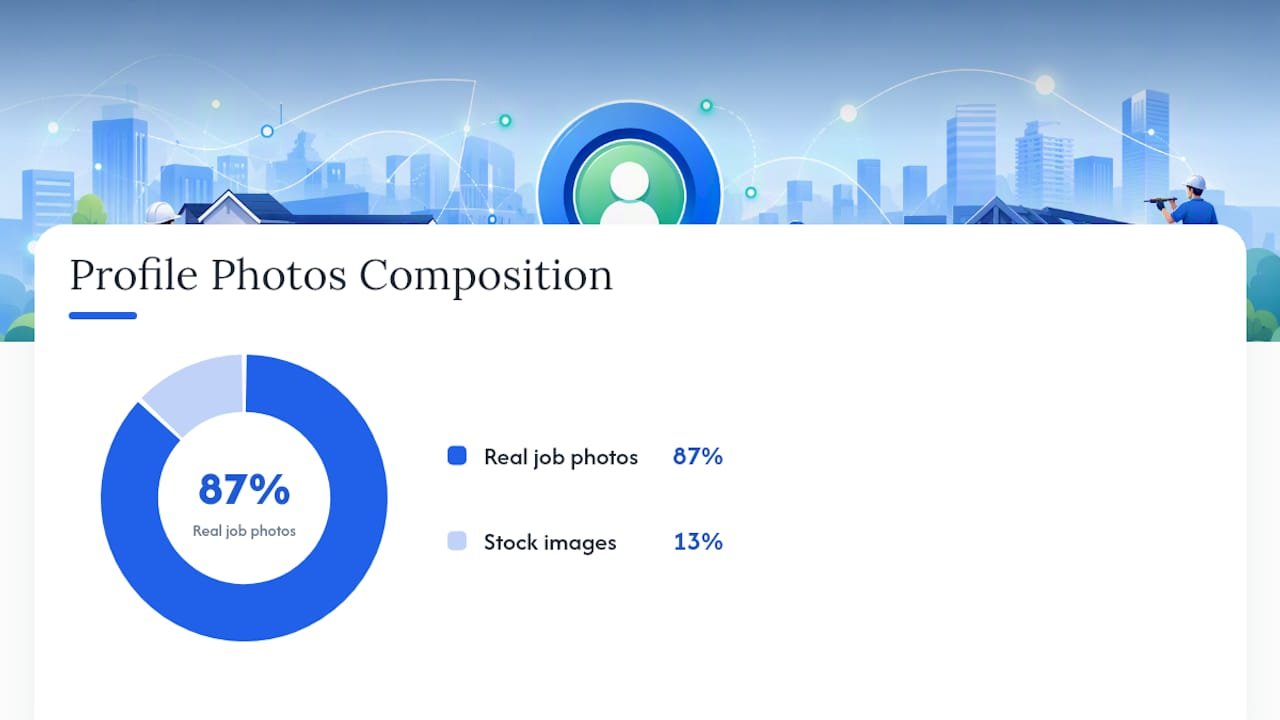
- Upload real job photos weekly. Stock images hurt more than they help.
- Publish a Google Post monthly with a recent project, a seasonal offer, or a tip.
- Monitor and answer the Q&A section. Seed a few common questions yourself if none exist yet.
- Fill in every business attribute Google offers (licensed, insured, veteran-owned, free estimates).
The most common pitfalls: choosing a broad category over an accurate one, letting your name and phone number drift out of sync across directories, and going months without a new review. Fix category and NAP mismatches first. They’re invisible to you but glaring to Google’s ranking algorithm.
Pro Tip: Photograph the job site before, during, and after every project this month, even the boring ones. A dull profile with 40 real photos will outrank a polished one with 6 stock shots.
How Should You Structure Service and City Pages?
One clear page per core service beats one bloated page trying to rank for everything. If you offer roofing, gutter installation, and storm damage repair, that’s three distinct pages, each targeting its own intent.
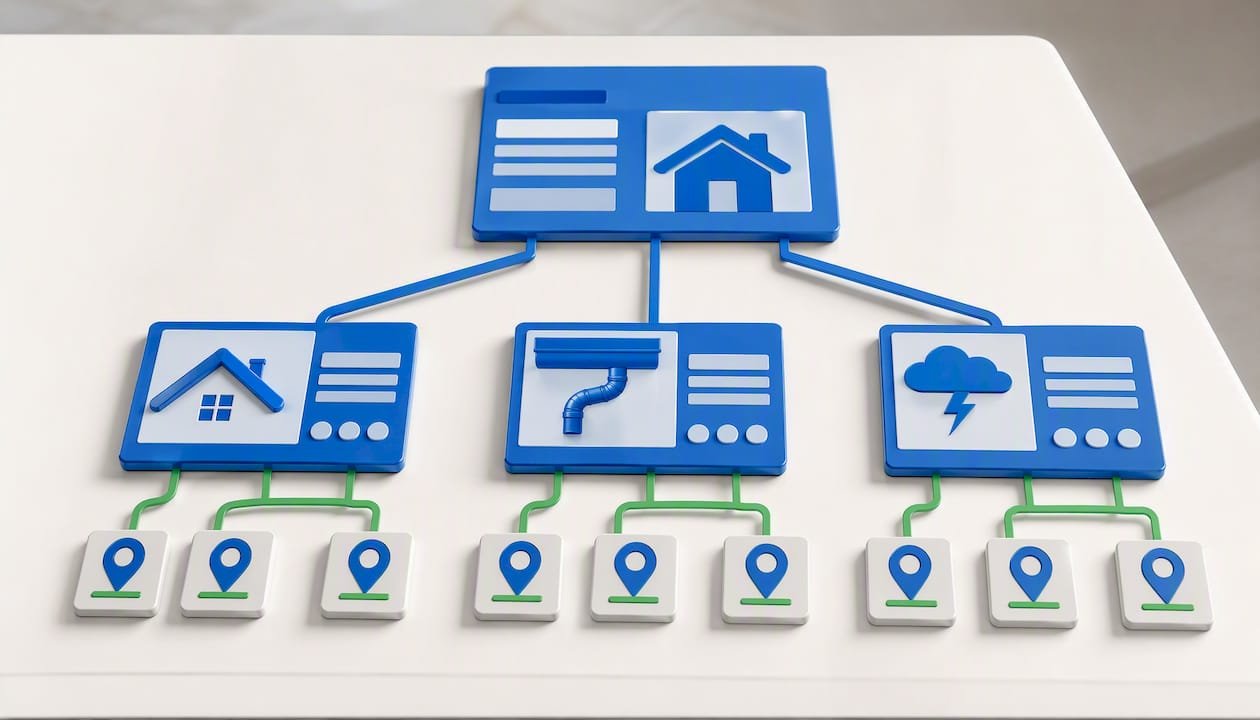
City pages deserve more restraint. Build them only for the 2 to 3 areas that actually generate revenue, not every town in your service radius. Service-area businesses that concentrate authority on a focused primary area consistently outrank competitors spreading thin content across a dozen thin location pages that all say the same thing with the city name swapped.
Each service or city page needs:
- A clear explanation of the service and what’s included in scope.
- A realistic price range, even a wide one (“$3,500 to $9,000 depending on square footage”).
- Three to five FAQs addressing the questions homeowners actually ask before calling.
- Local proof: a review, a completed project photo, or a mention of the neighborhoods you’ve worked in.
- Schema markup identifying the service type and service area so search engines and AI summaries can parse it correctly.
Avoid the trap of duplicating the same paragraph across ten city pages with only the city name changed. Google recognizes that pattern instantly, and it signals a thin, low-effort site rather than a credible local business. Link every city page back to its matching service page, and link every service page to your two or three priority city pages. That internal structure tells Google exactly which searches you’re built to answer.
How Do You Build Review Velocity Without Being Pushy?
Reviews aren’t just social proof anymore. Recency and consistency have become a stronger local-ranking signal than raw review count, which means a profile with two reviews last month beats one with fifty reviews from three years ago.
Ask for the review at the moment of highest satisfaction, which is usually right after final walkthrough or payment, not days later by email when the job has faded from memory. A simple text with a direct link works better than a long email request.
- Text a review link within an hour of job completion, while the work is still visible and fresh.
- Keep the ask short: “Thanks for choosing us. Mind leaving a quick review? Here’s the link.”
- Display your best reviews directly on the matching service page, not just a generic testimonials page.
- Respond to every review, negative ones included, calmly and specifically, without getting defensive.
- Space out review requests so you’re getting a steady trickle monthly, not one bulk request every six months.
Pro Tip: Train whoever collects final payment to send the review text on the spot. Handing this off to a “someday” email campaign is the fastest way to kill review velocity.
Which Technical Fixes Actually Move the Needle?
Not every technical SEO task deserves equal attention. For contractors, a handful of fixes carry outsized weight because they affect both rankings and whether visitors convert once they arrive.
Page speed and mobile experience top the list. A lean, fast build with optimized job photos tends to outperform a heavy page-builder site loaded with plugins, even when the plugin-heavy site looks flashier. Most homeowners are searching on a phone standing in their driveway, and a slow-loading gallery page loses them before they see a single photo.
- Compress and properly size every job photo before upload. Full-resolution camera files kill load times.
- Run a Core Web Vitals check quarterly and fix the worst offender each time rather than trying to perfect everything at once.
- Add local business schema, including service type and service area, so structured data matches what’s on the page.
- Keep your plugin count lean. Every unnecessary plugin adds load time and a potential security risk.
- Put click-to-call buttons and a short quote form (name, phone, service, zip) above the fold on mobile.
- Display license and insurance badges near your contact form, not buried in a footer.
What Content Actually Gets Contractors Booked?
Not all content pulls its weight. For contractors, three formats consistently produce leads: cost guides, project galleries, and problem-shaped FAQ pages that answer a specific worry before it becomes an objection on the phone.
Cost guides and timeline pages rank well because they answer the exact questions homeowners type into Google before they’re ready to call: “how much does a bathroom remodel cost,” “how long does a roof replacement take,” “do I need a permit for a deck.”
- Publish one cost guide per core service, updated at least once a year with current pricing ranges.
- Format project pages with the problem, the solution, materials used, and a photo sequence, then link to the relevant service page.
- Write FAQ content in direct question-and-answer format so AI-generated summaries and Google’s “People Also Ask” boxes can pull it cleanly.
- Use internal links from blog and FAQ content back to service and city pages, not just to your homepage.
Content built around real buyer questions consistently earns more organic traffic than generic “About Us” style pages, because it matches how homeowners actually search when they’re deciding, not just browsing.
Where Can Small Contractors Realistically Get Backlinks?
Skip the national PR pitch. A local-first backlink strategy built from trade associations, supplier directories, and community involvement is both realistic and repeatable for a business your size.
- Claim listings with your local Better Business Bureau chapter and relevant trade associations (roofing, plumbing, HVAC guilds).
- Ask suppliers and manufacturers you buy from regularly if they list certified or preferred installers on their site.
- Sponsor a local youth sports team or community event, which usually earns a link from the organization’s site.
- Run a quarterly citation audit using a free tool to catch name, address, or phone mismatches across directories.
- Reach out to local news or community blogs when you complete a notably large or unusual project worth covering.
None of this requires a PR agency. It requires a spreadsheet and twenty minutes a week.
Should You Run Paid Ads While SEO Builds?
Paid channels and SEO aren’t competitors. They solve different timing problems, and the smartest contractors run both with a clear handoff plan.
Local Service Ads work best for urgent, emergency-driven trades: burst pipes, no heat in January, a tree through the roof. You pay per lead, and costs climb as more competitors join the auction, but you get calls immediately while your organic presence is still developing. Google Ads fits better for planned, higher-consideration projects like kitchen remodels or new roofs, where homeowners are comparing multiple contractors over days or weeks.
- Use LSAs when speed matters more than cost per lead, especially in your first 6 months before organic traction builds.
- Use Google Ads for planned projects where you can afford a longer decision window and higher ticket value.
- Treat paid campaigns as a testing ground for messaging: whichever headlines and offers convert in ads usually convert on your service pages too.
- Track cost per booked job, not just cost per click, across every channel so you’re comparing apples to apples.
- Shift budget from paid to organic gradually as your SEO pages start ranking for the same terms.
The paid data you collect in month one becomes the SEO roadmap for month four.
What Timeline and Budget Should You Actually Expect?
Contractor SEO doesn’t move overnight, and any provider promising fast, guaranteed rankings is selling a fantasy. A realistic path looks like this:
- Months 0 to 3: GBP fully optimized, technical fixes complete, first service pages live. Expect minimal ranking movement but a cleaner foundation.
- Months 3 to 6: Early local pack visibility starts showing for your core service terms, and call volume from organic and map sources begins ticking up.
- Months 6 to 12: Compounding, steady lead flow as service pages, reviews, and citations mature together into consistent rankings.
Budget bands vary by market competitiveness, but a modest monthly investment typically buys GBP management and basic on-page work, while a larger budget adds content production, link outreach, and ongoing technical maintenance. Track these KPIs monthly: map pack visibility for your top terms, call volume, estimate requests, booked jobs, and cost per booked job across every channel combined. That last number is the only one that tells you if the whole system is actually working.
How Do You Vet an SEO Agency or Consultant Before Signing?
Hiring the wrong provider costs you more than the monthly fee. It costs you the months you spent waiting for results that were never coming.
Ask for case studies with real metrics attached, not vague claims of “great results.” Ask who your dedicated point of contact will be and how often you’ll get a report. A provider that can’t name a specific account manager on the call is telling you something about what happens after you sign.
- Request 2 to 3 case studies with specific before-and-after numbers, ideally in a trade similar to yours.
- Confirm reporting cadence in writing: monthly at minimum, with call volume and ranking data included.
- Ask directly what happens if rankings don’t move in 90 days. A confident, specific answer beats a vague reassurance.
- Walk away from anyone guaranteeing a #1 ranking or a specific timeline they can’t back up with a methodology.
- Ask how they’ll handle your Google Business Profile specifically, since that’s your highest-leverage asset.
Pro Tip: During the sales call, ask what your competitors are already doing for SEO. A provider who’s done actual research on your market will have a specific answer, not a generic pitch.
Preferic’s Track Record With Local and Small-Business SEO
Preferic specializes in SEO for small and local businesses, with dedicated tracks for organic SEO, local SEO, and AI-driven search optimization built for exactly the kind of service-area business a contractor runs.
- Every engagement includes a dedicated account manager and transparent monthly reporting, not a black-box dashboard you’re left to interpret alone.
- Contractor-specific service pages, like the ones built for roofers in San Diego and plumbers in Phoenix, show how the same local-first framework applies across trades and markets.
A Contractor’s Reality Check on Where SEO Actually Pays Off
Emergency trades and planned-remodel trades need different priorities. A plumber fielding burst-pipe calls needs GBP and call tracking dialed in immediately. A kitchen remodeler selling a $40,000 project needs cost guides and project galleries that support a longer decision. Treat them the same and you’ll waste budget.
The biggest mistake I see is contractors expanding their service area on paper before they’ve dominated their home market. A close second is ignoring Google Business Profile in favor of a prettier website nobody searches for by name. Start with your GBP and your core service area. Everything else is secondary until that’s solid.
Get Contractor SEO That Actually Books Jobs, Not Just Traffic
Contractor SEO services are often structured as monthly engagements with a dedicated account manager to provide consistent handling of your Google Business Profile, service pages, and reporting.
Preferic’s written plan starts with a straight look at your current GBP setup, your top competitors in the map pack, and where your website is leaking leads before it’s fixed. From there, Preferic backs its work with a 90-day guarantee. If organic traffic does not grow within 90 days, we refund you in full. You’re not locked into months of vague promises with nothing to show for it. Whether you’re a roofer, a plumber, or run a multi-crew remodeling business, the same local-first framework applies, and Preferic’s location-specific pages for trades like plumbers in Denver show that approach in practice. If you’re ready to see where your GBP and website currently stand, tell us about your business and get a written plan and exact monthly price instead of a generic pitch.
Sources
- SEO for Contractors: Plain-English 2026 Guide
- SEO for Contractors: A Practical Guide to More Leads, SEOlogist Inc
- Digital Marketing for Contractors: SEO, Ads & Website Guides
- Digital Marketing for Contractors | SEO, PPC + Follow-Up
- Is SEO dead? The real answer to the future of search, Roar Digital
FAQ
What Is an SEO Contractor?
An SEO contractor, in this context, is a consultant or agency that optimizes a construction or home-service business’s Google Business Profile, website, and content to generate more local leads and calls.
What Is SEO in Construction?
SEO in construction means optimizing a contracting business’s online presence, primarily its Google Business Profile and service pages, so it appears in local search results and the map pack when homeowners search for relevant services.
What Are the Four Types of SEO?
The four main types are technical SEO (site speed, schema, crawlability), on-page SEO (content and page structure), off-page SEO (backlinks and citations), and local SEO (Google Business Profile and map pack visibility), all of which apply to contractor websites.
Is SEO Being Phased Out?
No. Organic search still drives the majority of discovery clicks even as AI search summaries grow, and businesses with strong SEO foundations are typically the ones AI tools pull answers from.
How Long Does Contractor SEO Take to Show Results?
Most contractors see initial local pack movement within 3 to 6 months, with steady, compounding lead flow developing between months 6 and 12 as reviews, citations, and content mature together.
Recommended
- SEO Services for Roofers in San Diego, CA
- SEO Services for Roofers in Miami, FL
- SEO Services for Roofers in Austin, TX
- SEO Services for Plumbers in Phoenix, AZ
Want results like these for your business?
Preferic builds search programs for small and local businesses across the USA, with transparent reporting and a plan you can actually read.
Explore SEO Services