Most single-location small businesses should budget $800 to $2,500 a month for local SEO that actually moves the needle. Micro budgets under $500 can maintain a basic presence but rarely compete in crowded markets. Multi-location or high-competition brands should plan for $5,000 or more monthly. Start at the band that matches your competition level, not your comfort level, and expect your quote to shift with scope, market, and how fast you want results.
TL;DR:
- Small businesses should budget at least $800 to $2,500 monthly for effective local SEO, with higher budgets needed for competitive markets or multiple locations.
- Costs vary based on keyword competitiveness, number of locations, scope of services, and website complexity, often scaling linearly or slightly discounted with additional locations.
- Vendors typically offer pricing models such as monthly retainers, hourly consulting, project-based fees, or performance-based payments, each suited for different needs.
- Key line items like Google Business Profile management cost $100 to $400 monthly and have the greatest impact on local search visibility for the budget spent.
- Effective budgeting requires tracking leads and calls tied to SEO efforts, with results usually visible within three to six months and lasting over time if fundamentals are consistently maintained.
Table of Contents
- How Much Does Local SEO Cost by Business Size?
- What Drives Local SEO Pricing?
- What Are the Common Local SEO Pricing Models?
- What Do Local SEO Line Items Actually Cost?
- How Should You Budget and Track SEO ROI?
- What Red Flags Should You Watch for in a Proposal?
- How Preferic Approaches Local SEO Budgeting and Results
- What I’d Tell a Business Owner Setting This Budget for the First Time
- Ready to Put a Real Number on Your Local SEO Budget?
- Sources
- FAQ
How Much Does Local SEO Cost by Business Size?
Local SEO pricing splits into four practical tiers, and knowing which one fits your business saves you from either overpaying an agency for services you don’t need or underpaying a freelancer for work that won’t produce results.
Micro and DIY-plus-freelancer band: This tier suits solo operators, brand-new businesses, or owners willing to do some of the work themselves and hire a freelancer for technical pieces. At this level, expect Google Business Profile setup, basic citation cleanup, and occasional check-ins. More advanced services like content creation, link building, or competitive tracking may not be included. This approach works best in low-competition towns or niche trades with little online rivalry.
Small business professional band: $800 to $2,500 a month. This is where most single-location service businesses land, and it’s the range industry pricing surveys consistently point to for a managed campaign with real deliverables. Typical inclusions:
- Ongoing Google Business Profile (GBP) management and posting
- Basic on-page and technical fixes across your website
- Citation building and NAP (name, address, phone) consistency cleanup
- Monthly reporting on rankings, calls, and traffic
- One or two local landing pages or blog posts per month
Competitive and growth band: Businesses in dense metros or high-value verticals like legal, dental, or home services usually need this tier to see movement in local search results. Budgets here fund more frequent content, structured link-building outreach, and closer competitor tracking. Pricing often varies by location and industry competition.
Multi-location or enterprise band: Chains, franchises, and regional service brands typically pay per-location fees stacked on top of a base management retainer. Fees can vary significantly by the number of locations and services included. Enterprise SEO often includes schema markup at scale, review management across locations, and dedicated GBP oversight.
One-time audits and setup projects run separately from monthly retainers. A standalone local SEO audit generally carries a fee that varies by site size and market complexity, and a full GBP setup and optimization project incurs a one-time charge before ongoing management begins.
Here’s the practical test: if your quote falls well below the $800 floor and promises full-service local SEO, ask exactly what’s included. If it sits above $5,000 for a single location with no competitive justification, ask why.
What Drives Local SEO Pricing?
Two businesses in the same city can pay wildly different rates for what looks like the same service, and the difference almost always traces back to a handful of factors.
Market competition and keyword value matter more than almost anything else. A personal injury attorney in Chicago competes against dozens of firms with six-figure marketing budgets. A small bakery in a mid-sized suburb competes against maybe three other bakeries. Budget benchmarks show identical services costing more in dense metros and competitive verticals like legal, medical, and home services, simply because winning those keywords requires more work.
Number of locations scales cost almost linearly. Each additional location needs its own GBP listing, its own local landing page, its own citation cleanup, and often its own review strategy. Agencies typically discount per-location pricing slightly as you add sites, but the total still climbs.
Scope of services you’re buying changes the number fast:
- GBP management alone costs less than GBP plus technical SEO plus content plus links
- Adding review management and reputation monitoring adds a recurring line item
- Local link building is usually the most expensive service per hour because it requires outreach and relationship building, not just execution
Website complexity plays a bigger role than most owners expect. A five-page site for a solo contractor takes far less technical work than an e-commerce site with location pages for twelve service areas and hundreds of products.
Timeline expectations affect price too. Wanting results in three months instead of nine usually means paying for more hours of work packed into a shorter window, not a magic shortcut.
Agency vs. freelancer vs. in-house is its own budget decision. Agencies typically charge about 30% more than freelancers for similar scopes, reflecting higher overhead and broader bench strength across content, technical, and outreach specialists. Freelancers can be a smart choice for narrow, well-defined projects. In-house hires make sense once your SEO needs are large and constant enough to justify a full salary and benefits.
Pro Tip: Ask any vendor to break their quote into line items before you sign anything. A single “local SEO package” price tells you nothing about where your money actually goes.
What Are the Common Local SEO Pricing Models?
Vendors structure their fees a handful of ways, and understanding each model helps you compare apples to apples instead of getting lost in different formats.
Monthly retainers. The most common model for ongoing local SEO. You pay a flat fee each month for a defined bundle of work: GBP management, content, link building, reporting, and account management. Retainers typically run $800 to $5,000 depending on the tier described earlier, and they’re the right choice if you want consistent, compounding progress rather than a one-off fix.
Hourly consulting. Best for audits, strategy sessions, or coaching an in-house team rather than full campaign management. Hourly rates for experienced local SEO consultants generally fall between $75 and $200 an hour. This model suits a business owner who wants expert direction but plans to execute the work themselves.
Project-based fees. Used for discrete, finite work like a website migration, a full GBP setup, or a technical SEO cleanup after a redesign. Project fees are quoted as a flat total rather than a monthly rate, and they end once the deliverable is complete.
Performance-based pricing. Some vendors offer to charge based on ranking improvements or lead volume. This model sounds appealing but carries real risk: it can incentivize short-term ranking tricks that don’t survive a Google algorithm update, and it’s difficult to structure fairly when leads depend on factors outside SEO, like your sales team’s follow-up speed.
Three sample packages give you a starting checklist when comparing proposals:
Entry package (~$800 to $1,200/month): GBP management, citation cleanup, one blog post monthly, basic monthly reporting.
Growth package (~$1,500 to $2,500/month): Everything in entry, plus two to four local landing pages built over the campaign, ongoing review management, and light link-building outreach.
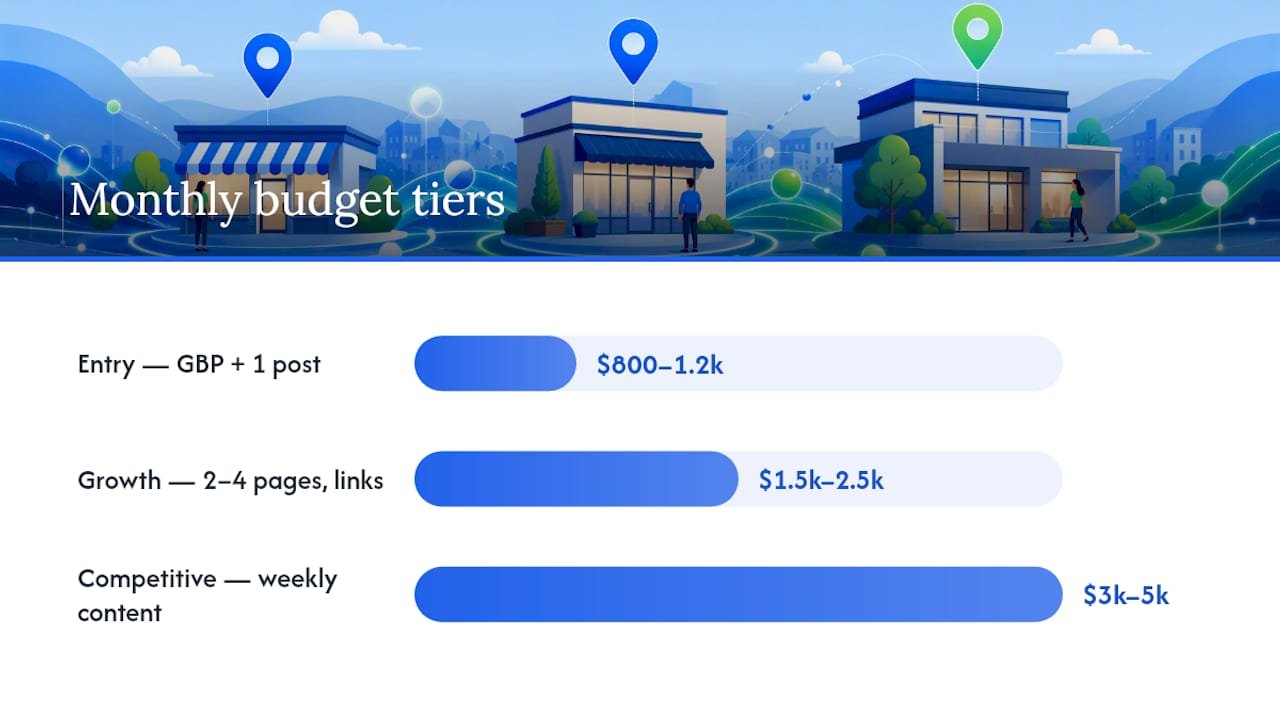
Competitive package (~$3,000 to $5,000/month): Everything in growth, plus weekly content, structured link-building campaigns, technical SEO audits every quarter, and competitor gap analysis.
What Do Local SEO Line Items Actually Cost?
Breaking a quote into individual services lets you sanity-check whether a vendor’s total price makes sense.
| Line item | Typical cost range |
|---|---|
| GBP optimization and monthly management | $100 to $400/month |
| Citation setup and cleanup | $300 to $500 one-time |
| Local landing page creation | $100 to $500 per page |
| Local blog post or content asset | $100 to $400 per post |
| Local link building | $300 to $1,500/month |
| Review management and monitoring | $100 to $300/month |
| SEO software and tools subscription | $50 to $300/month |
Ranges reflect typical agency package breakdowns and industry pricing data for small to mid-size local businesses.
Google Business Profile deserves the biggest share of attention relative to its cost. A fully optimized, regularly updated GBP is one of the most important signals for map pack visibility, and vendor reporting suggests a complete, active profile can drive noticeably more engagement than a stale or incomplete one. That makes GBP management one of the best dollar-for-dollar investments on this whole list, especially in the $100 to $400 monthly range.
Local link building costs the most per hour because it can’t be automated the way citation building can. A vendor promising 20 backlinks a month for $300 is a red flag, not a bargain, since genuine local link building usually produces a handful of quality placements monthly, not dozens.
How Should You Budget and Track SEO ROI?
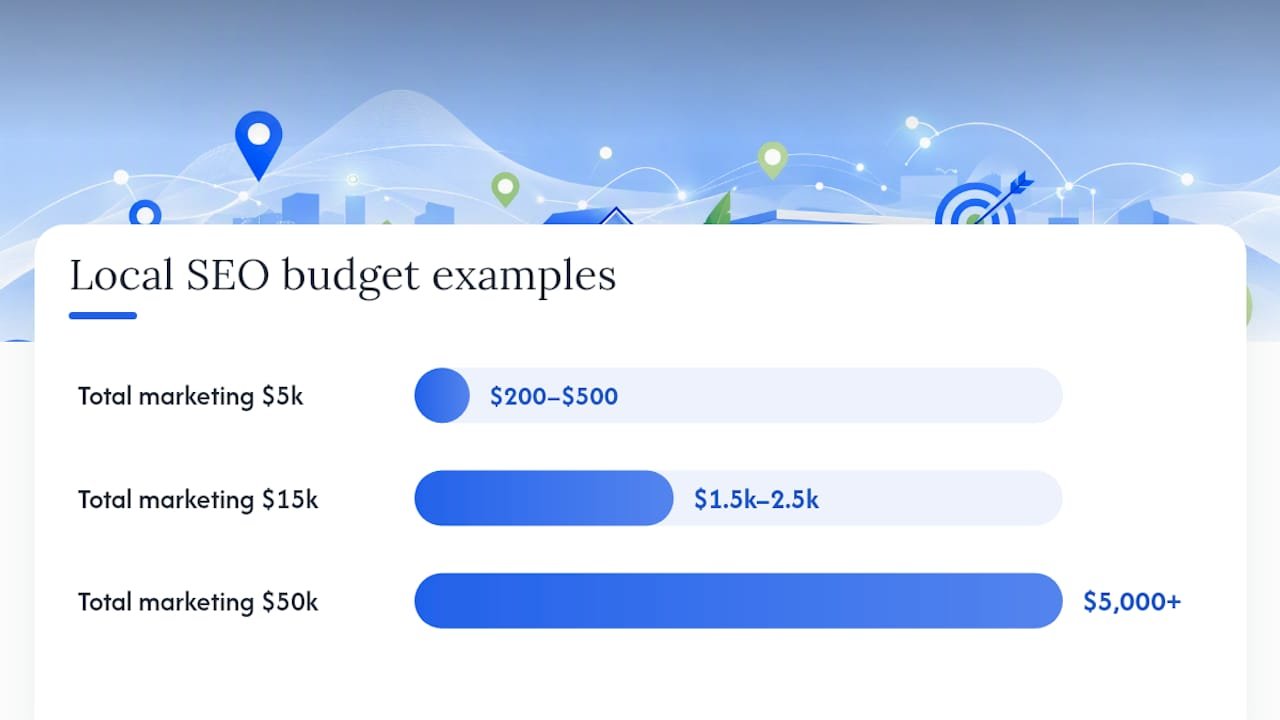
A practical starting rule: allocate roughly 1% to 10% of your total marketing budget to local SEO, adjusted by how much of your business depends on local search. A restaurant that gets most customers through walk-in visibility might sit near the low end. A home services company that lives or dies by “near me” searches should push toward the higher end.
Three scenarios show how that translates into dollars:
- A business spending $5,000/month on total marketing might allocate $200 to $500 to local SEO if local search isn’t a primary lead source.
- A business spending $15,000/month with local search as a core channel might allocate $1,500 to $2,500.
- A multi-location brand spending $50,000/month across marketing might dedicate $5,000 or more specifically to local SEO across all locations.
Track key performance indicators tied to revenue, such as GBP views and search appearances, map-pack impressions, organic leads generated, phone calls attributed to search, and actual booked jobs. Rankings alone do not directly indicate revenue impact.
Set up tracking before you spend a dollar: call tracking numbers tied to your GBP and website, UTM parameters on every local landing page, a CRM that logs lead source, and a working GA4 property. Insist on tying activity to revenue by reconciling tracked leads against your bookkeeping rather than accepting a rank report as proof of ROI.
Expect three to six months before you see meaningful movement, and six to twelve months for compounding results in competitive markets. Local SEO is not paid advertising. It builds slowly and then holds.
Pro Tip: Ask your vendor to send you raw call and form data monthly, not just a summary. Cross-check a sample of those leads against your own booking records to confirm the numbers hold up.
What Red Flags Should You Watch for in a Proposal?
A handful of warning signs separate a legitimate local SEO vendor from one that will waste your budget.
Guaranteed rankings. No one controls Google’s algorithm. Any vendor promising a specific ranking position by a specific date is either uninformed or dishonest.
No tracking or reporting plan. If a proposal doesn’t mention rank tracking, GBP performance metrics, or leads by source, you have no way to know if the work is paying off.
Vague deliverables. “Comprehensive SEO optimization” means nothing. Insist on a specific list: how many pages, how many links, how often GBP gets updated.
Suspicious link promises. Bulk backlink packages at low prices almost always come from low-quality or spammy sources that can hurt rankings rather than help them.
Before signing, insist your contract spells out exact deliverables, who owns the content and website access after the relationship ends, termination terms, and how change orders get priced if scope shifts mid-contract.
On the sales call, ask: What does reporting look like, and how often? Can I see an example of a past client’s monthly report? How do you track leads back to specific services? What happens if my rankings drop after an algorithm update? A vendor who answers clearly and specifically is worth far more than one who talks in generalities.
How Preferic Approaches Local SEO Budgeting and Results
Preferic Solutions builds data-driven SEO and digital marketing programs specifically for small and local businesses across the United States, which means budgets get built around what a business can actually measure, not around a generic package template.
A typical local SEO plan includes a dedicated account manager, consistent reporting, Google Business Profile optimization, and local content focused on pages that drive local search traffic. Instead of stopping at rankings, SEO activity can be tied to calls and leads through call tracking and conversion tagging, so a business owner can see which pages and campaigns produced actual booked jobs, not just ranking improvements. That reporting structure mirrors what this guide recommends asking for in any vendor proposal: leads by source, reconciled against real business outcomes.
What I’d Tell a Business Owner Setting This Budget for the First Time
If you’re a single-location business trying to pick a number, start at $800 to $1,200 a month, put most of it into Google Business Profile and citation consistency first, and only add link building once your GBP is fully dialed in. That order matters more than the total dollar figure most owners fixate on.
The mistake I see constantly is business owners treating local SEO like a light switch: flip it on, expect results in six weeks, and cancel when a rank tracker doesn’t show a page-one jump immediately. Local SEO compounds. It rewards businesses that fund the boring fundamentals consistently over businesses that chase whatever tactic sounds exciting this quarter.
Ready to Put a Real Number on Your Local SEO Budget?
Preferic offers an alternative to guessing at package prices or hiring freelancers: a dedicated account manager, reporting on leads and calls (not just rankings), and plans priced on your market and competition.
A written plan is the fastest way to find out where your budget actually needs to go, whether that’s Google Business Profile cleanup, technical fixes, or a content push in your specific service area. Plumbers can see how this plays out on Preferic’s SEO services for plumbers in Phoenix, and any small business owner ready to see real numbers can start with Preferic’s small business SEO plans, which start at $599 a month for Starter and $799 a month for Growth. If organic traffic does not grow within 90 days, we refund you in full. Tell us about your business and get a written plan and exact monthly price, built around your actual market instead of a generic package.
Sources
- Local SEO Pricing: How Much Does It Cost in 2025?
- Local SEO budget benchmarks by industry: What small businesses actually pay in 2026
- How Much Does Local SEO Cost? Pricing, Packages & ROI Explained
- Moz local SEO guide
FAQ
How much do local SEO services cost?
Most local SEO services cost between $500 and $5,000 a month, with the majority of single-location small businesses landing in the $800 to $2,500 range for a fully managed campaign.
Is SEO dead or evolving in 2026?
SEO is evolving, not dying. Search volume shifts are expected as AI tools change how people find answers, but local businesses still need to be found in maps, search results, and AI-generated answers, which still relies on the same GBP and website signals.
Is doing local SEO worth it for a small business?
Yes, for most businesses that depend on nearby customers. A well-optimized Google Business Profile alone tends to drive far more engagement than an incomplete one, and consistent local SEO work compounds over six to twelve months into steady, low-cost lead flow.
What is the 80/20 rule in SEO?
The 80/20 rule suggests that roughly 80% of your results come from about 20% of your efforts, which in local SEO usually means Google Business Profile optimization, citation consistency, and review generation deliver most of the visible gains before content and link building add further lift.
How do I know if a local SEO quote is fair?
Compare it against the line-item ranges for GBP management, citations, content, and link building, and be skeptical of any quote far below $800 a month promising full-service results or far above $5,000 for a single location without a competitive justification.
Recommended
- SEO Services for Plumbers in Phoenix, AZ
- SEO Services for Roofers in San Diego, CA
- SEO Services for Dentists in Austin, TX
- SEO Services for Roofers in Miami, FL
Want to own your local map pack?
Preferic helps small businesses across the USA rank higher, earn more reviews and turn local searches into paying customers.
Explore Local SEO Services