The fastest way to improve responsive search ad performance is to load each ad with diverse, non-redundant headlines and descriptions, pair those ads with Smart Bidding and broad match, and then judge success by conversions and cost per acquisition, not by chasing a perfect Google Ad Strength score. Preferic sees this sequence work across small business accounts precisely because it respects how Google’s ad system actually learns and serves combinations.
TL;DR:
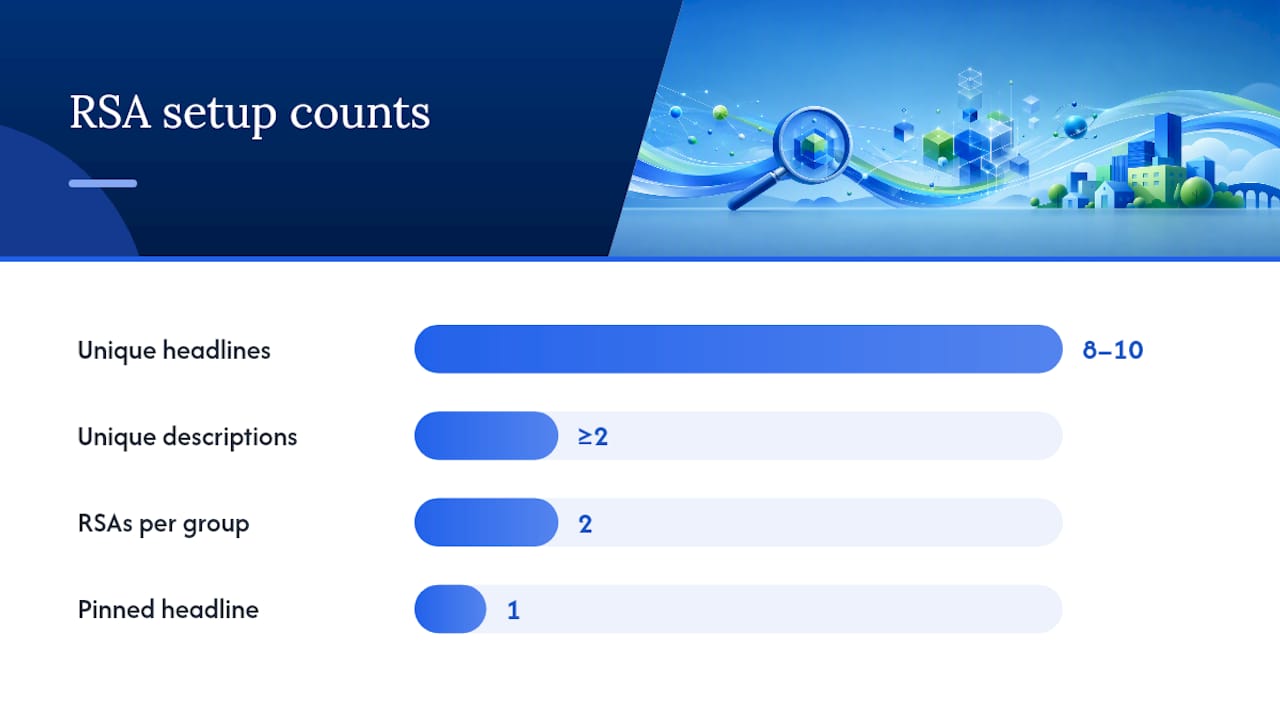
- Ads should contain 8 to 10 unique headlines and at least two descriptions to ensure enough variety for Google to test effective combinations.
- Pairing Responsive Search Ads with Smart Bidding and broad match keywords allows Google’s system to find high-intent queries that may not be manually added.
- Asset performance ratings require over 500 impressions per headline and over 2,000 impressions per ad before they provide reliable insights.
- Pin only the headlines or descriptions that must legally or strategically appear, aiming for no more than two or three pinned assets to preserve ad group variability.
- Continuous monitoring of asset reports and adjusting creative based on actual conversion data are more effective than initial setup or Ad Strength scores alone.
Table of Contents
- RSA Best Practices Checklist You Can Apply Today
- How RSAs Actually Assemble and Rate Your Assets
- Writing Headlines and Descriptions That Hold Up at Scale
- Pinning Strategy: When to Lock a Position and When to Let Go
- Ad Strength Is a Diagnostic Tool, Not a Scoreboard
- Building a Testing Process That Actually Tells You Something
- Launch Checklist: Setting Up RSAs to Actually Learn
- How Preferic Applies These RSA Best Practices for Clients
- Using Audience Signals to Sharpen RSA Targeting
- Adapting RSAs for Different Devices and Placements
- Author Perspective: The One Tactic Most Accounts Skip
- Get RSA Management Without Managing It Yourself
- Sources
RSA Best Practices Checklist You Can Apply Today
Before you touch anything else in your account, run through this list. It covers the setup mistakes that quietly cap performance for months.
- Write 8 to 10 unique headlines and at least 2 unique descriptions per ad. Google explicitly recommends this range because it gives the system enough raw material to test real combinations.
- Include your target keyword in multiple headlines, and keep several headlines completely keyword-free so you’re showcasing benefits, offers, or trust signals instead of repeating the same term five times.
- Pin sparingly. If you must lock a headline for legal or brand reasons, pin one primary line and leave the rest open.
- Pair every RSA with Smart Bidding and broad match keywords so Google’s system can chase high-intent queries you’d never think to add manually.
- Keep ad groups tightly themed around a single product or service, not a broad category.
- Give every RSA a unique final URL that matches what the ad promises.
- Aim for at least 2 RSAs per ad group, with at least one rated Good or Excellent in Ad Strength.
Statistic callout: Advertisers who move an ad’s Ad Strength from Poor to Excellent tend to see measurable lifts in clicks and conversions, according to Google’s own guidance, which is also where the 2 RSAs per ad group recommendation comes from.
Skip these, and you’ll spend weeks wondering why a technically “complete” ad underperforms. The setup work above takes maybe twenty minutes per ad group. The payoff compounds for as long as the campaign runs.
How RSAs Actually Assemble and Rate Your Assets
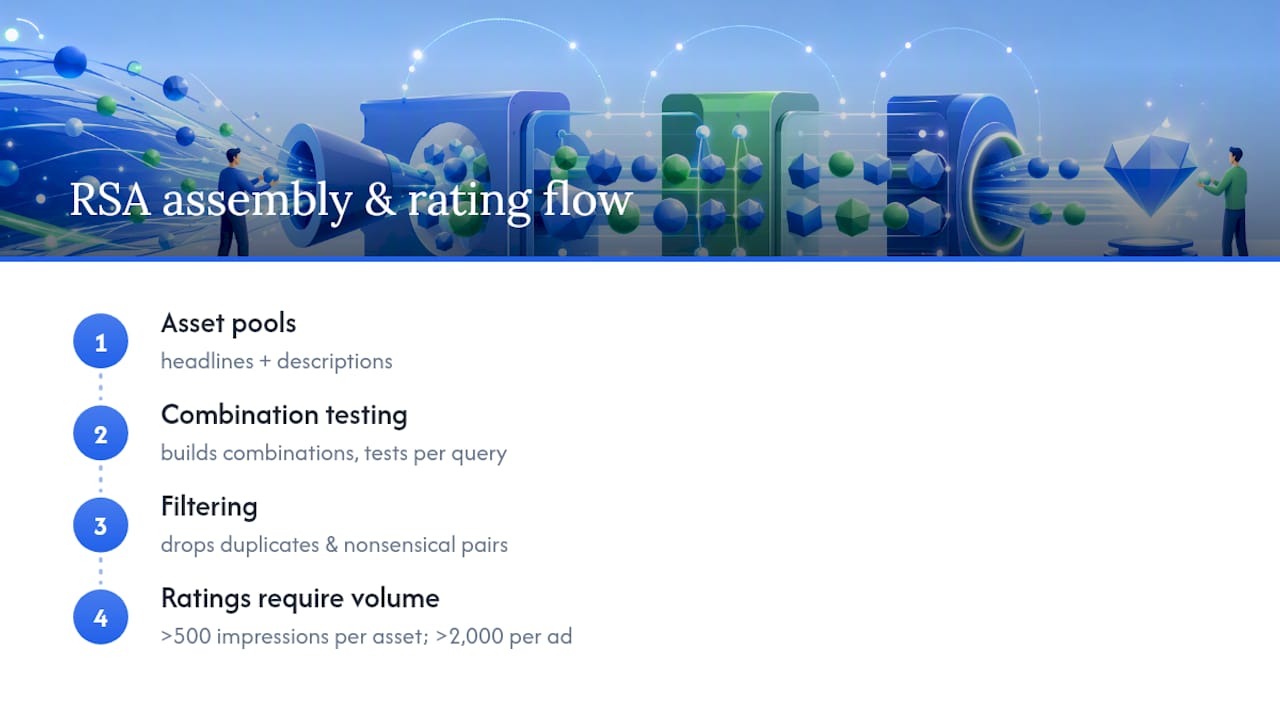
Google’s system doesn’t run your headlines in the order you typed them. It builds combinations from your pool of headlines and descriptions, tests different pairings against different search queries, and filters out duplicates or nonsensical pairings before anything ever gets served. That’s why redundant headlines waste a slot instead of adding coverage.
Asset performance ratings, the Learning, Low, Good, and Best labels you see per headline and description, don’t appear instantly. Google needs meaningful serving volume before it assigns a reliable rating. A single asset generally needs more than 500 impressions, and the ad as a whole needs over 2,000, before those ratings mean much. Pull the trigger on “optimizing” too early and you’re reacting to noise.
Volume matters for a second reason: the more traffic an ad group gets, the more query variations Google can test your assets against, which is what actually determines which headlines get shown for which searches. A low-volume ad group with ten headlines may never generate enough data to differentiate them. That’s a structural problem, not a copywriting one.
Writing Headlines and Descriptions That Hold Up at Scale
Quantity without quality just gives the algorithm more mediocre options to shuffle. Each headline should say something distinct: a price point, a guarantee, a specific service, a location, an objection handled. If two headlines could be swapped without anyone noticing, one of them is dead weight.
Formatting matters more than most marketers assume:
- Use sentence case in descriptions, not title case or ALL CAPS, which reads as spammy and can hurt approval odds.
- Include actual numbers where relevant, prices, percentages off, response times, since specific claims outperform vague ones in ad testing.
- Use your display path to reinforce relevance, especially when the domain itself doesn’t do it (a plumbing company’s display path might read “/emergency-repair” instead of a generic category).
- Avoid restating the same benefit with slightly different wording across three headlines. That’s still redundancy, even if the words don’t match exactly.
Google’s asset suggestions and auto-generated text customizations can speed up production, but every suggestion needs a human read before it goes live. Automated tools occasionally propose lines that are technically accurate but off-brand or misleading, and Google’s own writing guide flags this exact risk. Treat automation as a first draft generator, never a final approval step.
Pinning Strategy: When to Lock a Position and When to Let Go
Every asset you pin removes flexibility from the system. Pin three headlines to fixed positions, and you’ve effectively turned a responsive ad into three static text ads with two open slots. That’s rarely what you want, since it strips out most of the combinability that made RSAs worth using in the first place.
The practical middle ground is hybrid pinning:
- Pin one primary headline only when you have a genuine legal, compliance, or brand requirement, a required disclaimer, a trademarked tagline, a regulated claim.
- Leave the remaining 7 to 9 headlines and both descriptions unpinned so Google can keep testing combinations freely.
- If a second pin is unavoidable, cap it at two to three total pinned assets across the whole ad, and choose positions that still allow variety in the surrounding slots.
This approach preserves the message that legally or strategically has to appear, without gutting the machine learning’s room to find winning combinations. Google’s own guidance on pinning backs this exact trade-off: pin only what must show, leave everything else flexible.
Pro Tip: If you’re pinning for brand consistency rather than compliance, try pinning to a description instead of a headline. Descriptions get less visual real estate, so locking one there costs you less combinability than locking a headline slot.
Ad Strength Is a Diagnostic Tool, Not a Scoreboard
Ad Strength measures how much creative diversity and keyword relevance your ad has, nothing more. It doesn’t measure profitability, and treating “Excellent” as the goal instead of a signal leads teams to over-optimize copy while ignoring the metrics that actually pay the bills.
Here’s what each rating tends to signal:
- Poor or Average: usually too few unique headlines, heavy overlap between assets, or an ad group covering too many disconnected keyword themes.
- Good: reasonable diversity, but there’s still room to add distinct selling points or split a broad ad group into narrower ones.
- Excellent: strong asset variety and keyword coverage, giving Google’s system the most room to test and serve the best-fitting combination per query.
If Ad Strength stays low even after you’ve written a full set of unique headlines, the root cause is often account structure, not copy. Breaking an overly broad ad group into tightly themed clusters is frequently what actually fixes it, since narrower groups let each headline stay relevant across more of the query variations Google is testing.
Use Ad Strength to spot where creative or structural gaps exist. Use conversions, cost per acquisition, and return on ad spend to decide whether the ad is actually working. An “Excellent” ad with a poor conversion rate needs a landing page audit, not more headlines.
Building a Testing Process That Actually Tells You Something
Monitoring RSAs isn’t a “set it up once” task. Google’s asset reports update continuously, and the marketers who get the most out of RSAs check them on a schedule, not just when performance drops.
- Wait for adequate volume before acting on asset ratings, generally over 500 impressions per asset and over 2,000 per ad, so you’re reading signal instead of noise.
- Replace headlines and descriptions rated Low after they’ve cleared that volume threshold, rather than swapping copy reflexively during the first week.
- Run at least 2 RSAs per ad group with distinct creative themes, one price-driven, one benefit-driven, one trust-driven, so that when you compare performance between them, you’re learning something interpretable instead of comparing near-duplicates.
- Refresh creative around clear triggers: seasonal shifts, a new promotion, a sustained drop in conversion rate, or a landing page change, rather than on an arbitrary calendar.
The mistake most accounts make isn’t under-testing, it’s treating the initial setup as finished work. Search Engine Land’s guidance on standout search ads makes the same point: monitor asset reporting continuously and swap underperformers based on conversion data, not gut feeling about which headline “sounds better.”
Launch Checklist: Setting Up RSAs to Actually Learn
Get the setup right before you launch, and you save yourself weeks of cleanup later.
- Enable Smart Bidding on the campaign, then add broad match keywords so the algorithm has a wide net of queries to learn from rather than the narrow set exact match would allow.
- Verify every RSA has a unique final URL, and that URL actually matches the promise made in the ad copy. Mismatched message match kills conversion rate even when the ad itself is strong.
- Double check conversion tracking before you launch, not after. An RSA test built on broken tracking teaches you nothing.
- Structure ad groups around single, tightly related themes rather than broad service categories.
- Launch at least 2 RSAs per ad group so you have a real comparison from day one.
- Confirm the landing page content mirrors the ad’s core offer. Consistent content marketing between the ad and the page it leads to reduces bounce and supports Quality Score.
| Pre-launch item | Why it matters |
|---|---|
| Smart Bidding + broad match enabled | Lets Google’s system find high-intent queries automatically |
| Unique final URL per RSA | Prevents cannibalized attribution and message mismatch |
| Conversion tracking verified | Makes every downstream metric trustworthy |
| Tightly themed ad groups | Keeps headlines relevant across more query variations |
| 2+ RSAs per ad group | Enables real, interpretable comparison |
How Preferic Applies These RSA Best Practices for Clients
Preferic ties RSA creative testing directly to landing page performance rather than treating the two as separate workstreams. An ad group can have textbook Ad Strength and still underperform if the page it sends traffic to doesn’t match the offer, so every account gets reviewed for message match between ad copy and landing content before creative gets rewritten.
This same integrated approach shows up in Preferic’s organic work too. One fashion client saw a 210% increase in organic traffic in under a year, a result that came from aligning technical SEO, content, and measurement rather than any single tactic in isolation. The same discipline applies to paid search: data-driven testing, transparent reporting, and a dedicated account manager who actually reads the asset reports instead of letting them sit untouched.
Using Audience Signals to Sharpen RSA Targeting
RSAs don’t operate in a vacuum. Layering audience signals, remarketing lists, customer match, in-market segments, on top of your keyword and creative work gives Smart Bidding more context to work with when deciding which query and which combination deserves your budget.
Audience signals work best as a bidding input rather than a hard targeting restriction. Applying an “Observation” setting lets you watch how a segment performs and adjust bids accordingly, without shutting off traffic from people outside that segment who might still convert. That flexibility matters more with RSAs than with static ads, since the whole point of the format is letting the system find the best-fitting combination for each individual searcher.
Where this gets genuinely useful: pairing audience signals with distinct RSA themes. If you know returning visitors respond better to a specific offer, and first-time searchers respond better to a trust-building headline, you can lean on audience layering plus your themed RSA variants (the same price-driven, benefit-driven, trust-driven structure covered earlier) to let Smart Bidding surface the right combination to the right segment. You’re not manually forcing which headline shows to whom. You’re giving the algorithm better inputs to make that call itself, then watching the conversion data to confirm it’s working.
Adapting RSAs for Different Devices and Placements
A headline that reads perfectly on desktop can get truncated on mobile, where limited screen space means fewer characters display before the ad gets cut off. Google handles most of this rendering logic automatically, choosing which headline and description combination fits, but that doesn’t mean device behavior is out of your hands.
Front-load your most important information in each headline rather than saving the key detail for the end. If a price, guarantee, or urgent offer only shows up in the last few words of a 30-character headline, mobile truncation may cut it before the searcher ever sees it. Writing tighter, front-loaded headlines protects against that regardless of which device ultimately renders the ad.
Search placement also varies: ads can serve on Search Partner sites and across different result positions, where visual space and surrounding content differ from a standard Google results page. There’s no separate RSA setup required for this, the same asset pool serves everywhere, but it’s another reason redundant or vague headlines cost you more than they seem to. The system needs enough distinct, high-quality options to pick from no matter where or on what device the ad ends up shown.
Author Perspective: The One Tactic Most Accounts Skip
The core recommendation here isn’t complicated: write diverse assets, hand the algorithm real flexibility through Smart Bidding and broad match, and measure results by conversions rather than a vanity Ad Strength score. Most accounts get the asset counts right and still underperform because they either over-pin out of nervousness or under-structure their ad groups.
The tactic worth testing that almost nobody runs deliberately is combining hybrid pinning with campaign-level text customizations, locking only the one line that legally must appear, while using dynamic text insertion elsewhere to auto-adjust pricing or inventory claims per campaign. It keeps compliance intact without sacrificing the combinability that makes RSAs worth using.
— Deepak
Get RSA Management Without Managing It Yourself
PPC and Google Ads management services can relieve you from handling RSA setup, testing, and reporting in-house, eliminating guesswork from tweaking headlines based on hunches instead of conversion data.
If you’d rather have someone else build tightly themed ad groups, write ten-headline sets, and monitor asset performance against real thresholds, these tasks can be handled by experienced teams, paired with transparent reporting so you always know which changes drove which results. Small businesses in service categories like plumbing, roofing, and dental care often benefit from this setup instead of piecing together RSA management between other priorities. Visit Preferic to talk through what managed PPC support would look like for your account, and get a plan built around your actual conversion goals instead of a generic template.
Sources
- Set up your ads for success – Google Ads Help
- Responsive Search Ads: A guide to writing ads that perform (Google PDF)