Multi-location SEO succeeds when each physical location has one authoritative page, a verified Google Business Profile, and a centralized master data system feeding every directory and map platform. The immediate move: audit your locations this week, confirm one canonical page and GBP listing per address, and put your location data under a single source of truth. Everything below shows you how to build that system and keep it running as you scale.
TL;DR:
- Verifying and standardizing Google Business Profiles quickly impacts visibility since corroborated signals are favored by AI-driven local search.
- Location pages should be built around real signals like staffed presence, unique hours, or distinct services, not merely for quantity.
- Consistent URL structures, accurate schema markup, and a centralized master data system are essential to maintain trust across directories and search engines.
- High-quality location pages include verified NAP, local photos, specific services, driving directions, and reviews to enhance local relevance.
- Regularly track local performance with location-specific data, updating and cleaning information to prevent ranking and trust issues.
Table of Contents
- Your Fastest Wins in Multi-Location SEO
- How Should You Structure and Maintain Location Pages?
- How Do You Optimize Google Business Profiles at Scale?
- Choosing a URL Structure That Won’t Fight You Later
- Building a Master Data System That Directories Trust
- Turning Reviews and Local Links Into Local Prominence
- Tracking Performance Location by Location
- Governance: The Process That Lets You Scale Without Chaos
- What Signals Help AI and Maps Recommend Your Locations?
- Preferic’s Approach to Multi-Location SEO Results
- Making Offline Marketing Work With Your SEO
- Handling Multi-Language and Multi-Region SEO
- Prioritizing Multi-Location SEO at Any Scale
- Get a Local SEO Partner Built for Multi-Location Growth
- Where to Verify These Practices Yourself
- Sources
Your Fastest Wins in Multi-Location SEO
Not every task on your list deserves equal attention this month. Some fixes take an afternoon; others need a developer sprint and a signature from corporate.
Start with the items your local managers can execute without waiting on IT: claiming and verifying Google Business Profiles, fixing NAP (name, address, phone) mismatches, and responding to unanswered reviews. These carry outsized weight because AI-driven local search now favors corroborated entity signals across Google, Maps, GBPs, and third-party directories, meaning a mismatched phone number on one directory can quietly undercut trust everywhere else.
Medium-effort work, like building or consolidating location pages and setting up call tracking, usually needs a content team and a few weeks. The heaviest lift, a true master data platform and a local backlink program, needs corporate buy-in and budget.
Prioritize in this order:
- Verify and standardize every GBP listing (fastest, highest impact)
- Fix NAP inconsistencies across your top 10 directories
- Publish or fix location pages for your highest-traffic branches
- Set up UTM tracking and call tracking per location
- Build a centralized data repository for long-term scale
- Launch a review response and local link program
Items three through six typically require coordination between marketing, local staff, and sometimes a developer.
How Should You Structure and Maintain Location Pages?
The biggest mistake multi-location brands make is treating location pages as a numbers game. More pages does not mean more visibility. Search engines reward pages built around real locations, markets, and service areas rather than dozens of near-duplicate city pages that all say the same thing with a different town name swapped in.
When does a location actually need its own page?
Give a physical address its own page when it has real signals to back it up: a staffed location, unique inventory or services, distinct hours, or its own review history. A service-area business covering twelve suburbs from one warehouse does not need twelve thin pages. It needs one strong hub page with clear service-area language because Google requires service-area businesses to hide their street address on GBP while still calculating rankings from that hidden physical point.
A useful decision rule: if you cannot fill a page with genuinely unique local content, that location deserves a section on a regional hub page instead of a standalone URL.
What belongs on a high-quality location page?
Every location page needs the same core skeleton, filled in with real, local specifics:
- Full NAP block matching your GBP exactly, including suite numbers and cross streets
- Current hours, including holiday exceptions
- Services or products actually offered at that address, not a copy-pasted brand list
- Staff names or a manager photo, when appropriate for the business type
- Driving directions, parking notes, and a map embed
- Local FAQs pulled from real customer questions at that branch
- Unique photos taken at that address, not stock imagery or another branch’s shots
- A clear conversion point: phone number, booking widget, or contact form
Pro Tip: Photograph the exterior signage, the parking lot, and one interior shot for every location during a single regional visit. It is the cheapest way to kill duplicate-content complaints and gives each page something a competitor’s template cannot fake.
What should you standardize versus localize?
Standardize your page’s structural blocks, meta title formula, schema markup, and calls to action. Localize the copy in the hero section, the services list, staff bios, and the FAQ content. A plumbing company’s service page for a specific metro can share a template with every other city page while still reading as written specifically for that neighborhood.
When you have overlapping pages targeting the same intent, run an inventory, cluster by search intent, and consolidate. Redirect the weaker page to the stronger one with a 301, and set a canonical tag pointing to the surviving URL so search engines stop splitting authority between duplicates.
How Do You Optimize Google Business Profiles at Scale?
Your Google Business Profile is often the first thing a searcher sees, and for many local queries, the only thing they see. Getting it wrong across dozens of locations compounds fast.
- Claim and verify every location, using Google’s bulk verification process for chains with 10 or more addresses instead of verifying one by one.
- Match every field, name, address, phone, hours, and website URL, exactly to your location page and master data record.
- Select the most specific primary category available, then add relevant secondary categories and attributes (wheelchair access, appointment-only, women-owned, and similar).
- Upload services, products, and at least 10 photos per location, refreshed quarterly.
- Monitor and answer the Q&A section before customers post misleading answers.
- Post updates, offers, and events weekly, or at minimum monthly, per location.
Google’s own guidelines for representing a business spell out exactly which fields it expects and how they should match your other properties, and profiles that drift from those specs risk suspension, not just lower rankings.
Two habits separate the brands that manage this well from the ones drowning in it:
- Add UTM parameters to every GBP website link so GA4 can isolate GBP-driven traffic from organic search traffic
- Set up automated review alerts per location so no branch goes silent for weeks
Choosing a URL Structure That Won’t Fight You Later
Subfolders, subdomains, or separate domains: pick one and commit, because switching later costs you months of redirect cleanup and lost authority.
Subfolders (yoursite.com/locations/denver) are the right default for most multi-location brands. They consolidate domain authority under one roof and are the easiest for a single team to manage. Subdomains (denver.yoursite.com) make sense only when a location operates as a near-independent business unit with its own content team. Separate domains rarely make sense for SEO purposes; they fragment link equity and multiply the technical maintenance load.
Once you pick a structure, lock in naming conventions:
- Use a consistent pattern like /locations/city-state/ to avoid collisions between same-named cities in different states
- Set a canonical tag on every page pointing to itself unless it is a genuine duplicate being consolidated
- Submit a dedicated XML sitemap segment for location pages so crawlers can prioritize them during large-scale updates
- Mirror your URL slug, GBP business name, and schema markup so the same entity name appears everywhere
Structured LocalBusiness schema with accurate core facts and sameAs links is what ties your URL, your GBP listing, and your knowledge graph presence into one recognizable entity instead of three loosely related signals.
Building a Master Data System That Directories Trust
Every inconsistency between your website, your GBP, and a third-party directory chips away at the trust signals search engines and AI assistants use to decide whether to recommend you. The fix is structural, not cosmetic.
Build one master location repository, a single spreadsheet or database holding the verified name, address, phone, hours, and category for every branch, and treat it as the only source anyone is allowed to edit. A centralized location data system with automated distribution reduces listing errors that would otherwise creep into individual directory submissions one by one.
From that master file:
- Push updates to Google, Bing, Apple Maps, and major aggregators like Data Axle and Foursquare on a set schedule, not ad hoc
- Audit your top 20 directories quarterly for drift, since even a suite number typo can create a duplicate listing
- Assign one owner for moves and closures, since a closed location left live on five directories actively damages trust
- Flag shared-address listings (co-working spaces, franchise territories) so they don’t get merged incorrectly by automated systems
Turning Reviews and Local Links Into Local Prominence
Reviews and backlinks do something a location page alone cannot: they tell search engines and AI systems that real people, in that specific area, vouch for that specific branch.
Set up an automated request flow that texts or emails customers within a day of service, timing matters more than most owners assume. Pair it with response templates for your team, one for five-star reviews, one for neutral feedback, and one for complaints, so every branch replies instead of a rotating cast of managers improvising.
Local backlinks carry more weight than another national directory listing ever will:
- Sponsor a local youth sports team or community event tied to a specific branch
- Join the chamber of commerce in each market and claim the member directory listing
- Pitch a local news outlet on a story angle tied to that location, a grand opening, a hiring milestone, a community partnership
- Publish a short case study featuring a real customer from that market, with a link back to the location page
Pro Tip: One genuine link from a city newspaper or chamber of commerce site usually outweighs ten generic business directory links, because locality and relevance matter more to search engines than raw volume.
Never offer incentives for positive reviews and never filter negative feedback before it posts. Google’s policies treat incentivized or gated reviews as a violation, and getting caught risks the profile itself, not just a ranking dip.
Tracking Performance Location by Location
You cannot fix what you cannot see by branch. Build a UTM structure that tags every campaign with a location identifier (utm_content=denver-branch), then connect GBP website clicks and call button taps into GA4 and your CRM so the data lands in one place instead of six.
A workable measurement stack:
- Assign a unique tracking phone number to each location’s GBP and website
- Tag every contact form with a hidden location field so leads route and report correctly
- Build one dashboard with location as a filterable dimension, not twelve separate reports
- Track core KPIs per branch: GBP views, direction requests, calls, form fills, and organic sessions
Watch for locations whose traffic holds steady while conversions drop. That pattern usually points to a broken phone number, an outdated hours listing, or a review score that quietly slipped, not a ranking problem at all. Flag those branches for manual audit before assuming the fix is more content.
Governance: The Process That Lets You Scale Without Chaos
Operational governance, defined page types, clear creation criteria, required local content, and consistent URL conventions is what separates chains that scale smoothly from ones that accumulate SEO debt with every new opening.
Assign ownership clearly: corporate controls the template, schema, and brand standards; local managers own photos, staff bios, and review responses within guardrails. Give local staff a locked-down CMS role that lets them edit approved fields without touching page structure or metadata.
Set a minimum content standard before any page goes live, real photos, a filled-in FAQ, verified hours, so no location launches with a placeholder page that looks abandoned. Build a retirement process too: when a branch closes, the page redirects, not whenever someone notices.
- Run a quarterly audit checklist covering NAP accuracy, GBP completeness, and page freshness
- Require sign-off from one governance owner before any new location page publishes
- Train local managers with a one-page style guide instead of a 40-page brand manual nobody reads
- Track SLA turnaround for corporate requests (new page, schema fix) so local teams know what to expect
Pro Tip: Treat your location page template like a product, not a document. Version it, log changes, and roll updates out in batches instead of editing pages one at a time.
What Signals Help AI and Maps Recommend Your Locations?
Search engines and AI assistants increasingly cross-reference the same signals to decide whether your location is trustworthy enough to recommend: corroborated NAP across sources, review volume and recency, local backlinks, unique on-page content, and sameAs links connecting your GBP, website, and social profiles into one recognized entity.
Structured data does the heavy lifting here. LocalBusiness schema with accurate geo coordinates, hours, and a sameAs array pointing to your GBP, Facebook, and Yelp listings gives machines a confident answer instead of three conflicting guesses.
Write short, factual sentences on each location page that state exactly what a large language model would need to recommend you correctly: the street address, the days you are open, your specialty, the neighborhood you serve, and the year you opened there. Concrete, verifiable claims perform better than marketing language for exactly this purpose.
- Add LocalBusiness schema with sameAs links to every location page
- Cross-check GBP, website, and directory data monthly for drift
- Write one factual summary sentence per location that states name, address, and specialty plainly
- Test visibility by asking an AI assistant directly which branch it recommends for a given query and neighborhood, and compare the answer to your data
Preferic’s Approach to Multi-Location SEO Results
Preferic built its reputation on measurable outcomes, and the same data-driven method applies directly to multi-location governance.
The steps in this guide map to real Preferic services: master data governance keeps NAP consistent across every directory, GBP management handles bulk verification and monthly optimization, location page builds follow the anatomy outlined above, and transparent reporting gives you a dashboard broken out by branch instead of one blended number.
- Master data governance and citation distribution across directories and maps
- GBP claiming, verification, and ongoing optimization for every branch
- Location page design and local content production at scale
- Location-level reporting tied to a dedicated account manager
If your locations are inconsistent across directories or your GBPs have gone unmanaged for months, a focused audit is the fastest way to see where you stand before committing to a larger rollout.
Making Offline Marketing Work With Your SEO
A radio spot, a flyer at a local farmers market, or a sponsored booth at a county fair does more than build brand awareness if you connect it back to your digital footprint deliberately.
Print your GBP-verified phone number and address on every piece of offline material, matching your master data exactly, so any customer who searches your name after seeing a truck wrap or a billboard finds a listing that confirms what they just saw. Use a dedicated tracking number on print and radio ads so you can see, in your CRM, how much offline spend actually drives calls to a specific branch.
Local sponsorships and event participation double as backlink and citation opportunities. A booth at a home and garden show is a marketing expense; a mention on that show’s website with a link to your location page is also an SEO asset. Coordinate your marketing and SEO teams so every offline placement includes a URL or QR code pointing to the relevant location page, not the generic homepage.
Press releases for grand openings or community involvement, when picked up by local news, generate exactly the kind of local backlink that a generic directory listing cannot replicate. Treat every offline touchpoint as a chance to reinforce the same NAP, the same URL, and the same story your digital presence already tells.
Handling Multi-Language and Multi-Region SEO
Chains operating across language or regional borders face a layer of complexity single-market brands never encounter: the same location page strategy has to work in more than one language without confusing search engines about which version to show whom.
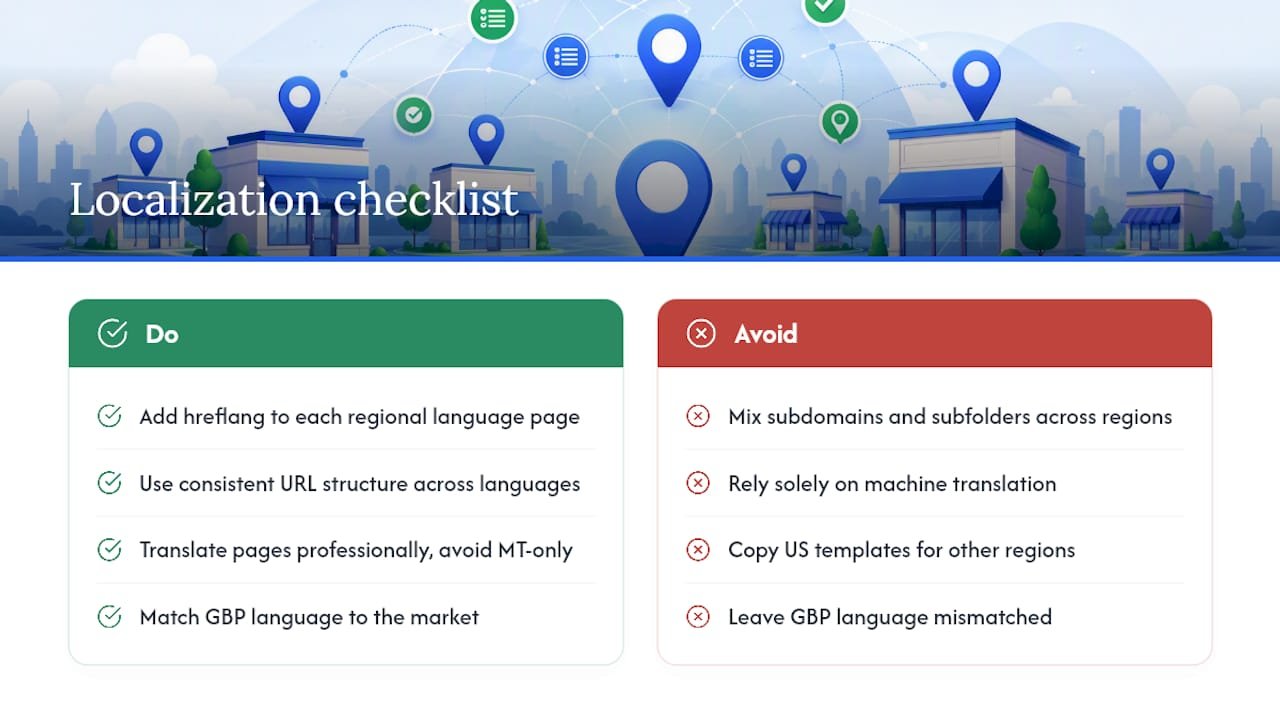
Use hreflang tags on every regional or language variant so Google understands that a Spanish-language Miami page and its English counterpart serve the same intent for different readers, not competing duplicate content. Keep URL structure consistent across languages (/es/locations/miami/ alongside /locations/miami/) rather than mixing subdomains for some regions and subfolders for others.
Translate location page content professionally rather than through automated tools alone, particularly the local FAQ and service descriptions, since machine translation errors on a page meant to build trust can undercut the exact signal you’re trying to send. Keep your GBP language setting matched to the primary language of that market, and consider a second, language-specific profile only where Google’s guidelines explicitly support it for that region.
Currency, phone formatting, and business hours conventions vary by region too. A location page for a Canadian branch needs Canadian phone formatting and, where relevant, bilingual content that meets local expectations, not a direct copy of a US template with the area code swapped.
Prioritizing Multi-Location SEO at Any Scale
If you run one location, fix your GBP and NAP parity this week; that alone often moves the needle faster than any other single action. At 10 locations, the medium-term work matters more: build proper location pages and a review acquisition system before you touch backlinks. At 100 or more, the strategic layer becomes unavoidable: without a master data platform and a governance process, every new location you open just adds more inconsistency to fix later.
Pilot an agency relationship when your internal team can execute tactics but lacks time to run the governance layer, that data platform, and the reporting cadence that catches problems early. Phase the work to show ROI in 90 days: GBP and NAP fixes first, since they’re fast and visible, then location pages, then the backlink and data infrastructure that pays off over the following year.
Get a Local SEO Partner Built for Multi-Location Growth
A specialized SEO agency can be an alternative to hiring a full-time in-house SEO team for multi-location management, without the overhead of another salary and without a long-term contract locking you in. If your locations need GBP cleanup, consistent location pages, or a master data system that keeps every directory in sync, local SEO services can handle the operational work outlined in this guide, from bulk verification to location-level reporting.
Field service and multi-location brands, from plumbing companies in Denver to dental practices and roofing contractors in other metros, use this same framework to bring every branch up to a consistent standard instead of letting the busiest location get all the attention. Before investing in a larger rollout, ask Preferic for a written plan and exact monthly price, covering your NAP data, GBP profiles, and location pages.
Where to Verify These Practices Yourself
Cross-check any agency’s recommendations, including this guide, against primary sources before rolling out changes across dozens of locations.
- Google’s guidelines for representing a business covers the exact fields and rules GBP enforces
- Search Engine Land’s multi-location SEO guide breaks down page structure and schema recommendations in more depth
- Backlinko’s multi-location SEO breakdown walks through the core operational checklist step by step
- Tools like Google Search Console, GA4, and a dedicated listing management platform help automate the data distribution and tracking this guide recommends
Sources
- Multi-Location SEO: How To Win Google & AI Search Visibility At Scale | Search Engine Journal
- Multi-location SEO: Boost local visibility for each location | Search Engine Land
- Guidelines for representing your business on Google | Google Support
Recommended
- SEO Services for Plumbers in Phoenix, AZ
- SEO Services for Plumbers in Dallas, TX
- SEO Services for Roofers in San Diego, CA
Want to own your local map pack?
Preferic helps small businesses across the USA rank higher, earn more reviews and turn local searches into paying customers.
Explore Local SEO Services